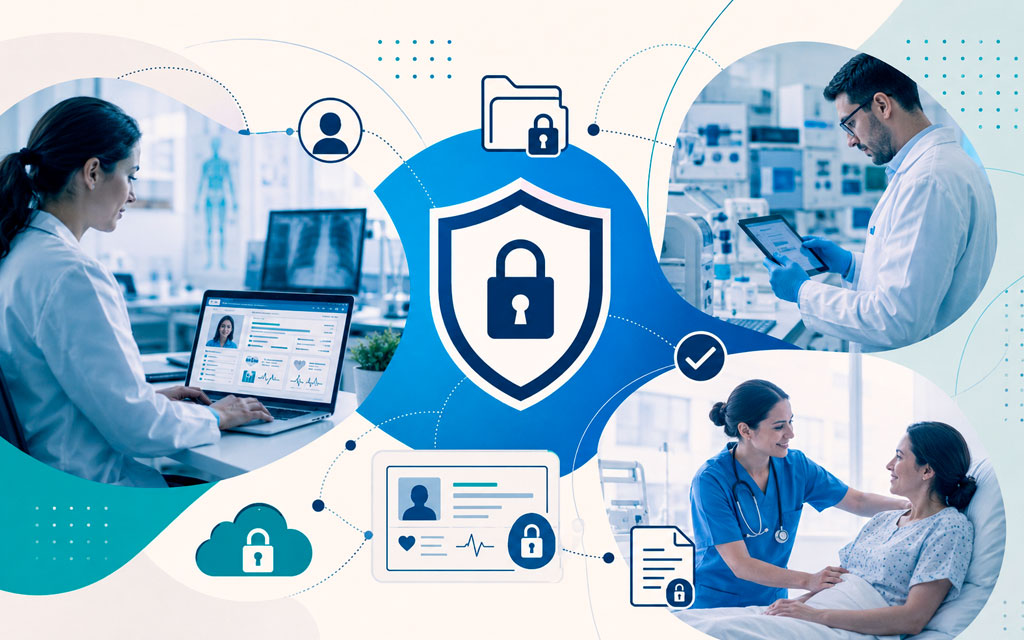
A patient data protection It has become a strategic responsibility for laboratories, clinics, and companies operating in the healthcare field. After all, information such as registration data, test results, reports, service history, and laboratory records require rigorous care at every stage of the process.
Furthermore, health-related data is considered sensitive personal data under the LGPD (Brazilian General Data Protection Law), which requires even greater attention to the processing, storage, sharing, and access control of this information. The LGPD itself defines sensitive data as data that may involve, among other things, information relating to health, sex life, genetic or biometric data linked to a natural person.
Therefore, protecting patient data is not just a legal obligation. It is also a way to preserve trust, reputation, and the continuity of laboratory operations.
Why is protecting patient data so important?
Laboratories handle a large volume of personal and sensitive information daily. From the initial patient registration to the release of test results, different data circulate through systems, integrations, internal areas, and communication channels.
In this context, any failure can have significant impacts. Unauthorized access, incorrect report submission, misconfigured permissions, or a system vulnerability can compromise patient privacy and operational security.
Furthermore, the LGPD establishes rights for the holders of personal data, that is, the people to whom this information belongs. This reinforces the need for transparency, organization, and governance in data processing.
For laboratories, this means that protecting information needs to be part of the routine, internal processes, and company culture.
What patient data needs to be protected?
Patient data protection involves different types of information. Key examples include:
- Name, CPF (Brazilian tax identification number), phone number, email address, and physical address;
- Date of birth and identification information;
- Agreement details or payment method;
- requested tests;
- laboratory results;
- medical reports;
- genetic, biometric or health-related information;
- service history;
- System access logs.
Some of this data is personal. Other data is sensitive. However, all of it must be handled responsibly, following clear criteria for security, privacy, and purpose.
This means the lab needs to know what data it collects, where it is stored, who can access it, how long it is kept, and with whom it can be shared.
1. Map the personal data processed by the laboratory.
The first step is to understand the data pathway within the operation. In other words, it’s necessary to map how information enters, circulates, is stored, accessed, shared, and discarded.
This mapping helps the laboratory answer important questions:
- What patient data is collected?
- In which systems is this data stored?
- Who has permission to access them?
- Is this data shared with third parties?
- Is there integration with other systems?
- Is there control over the lifecycle of this information?
Without this mapping, it becomes much more difficult to protect data effectively. After all, it’s impossible to adequately protect what the company doesn’t know or control.
2. Control access to information
Not every employee needs access to all data. Therefore, access control is one of the cornerstones of patient data protection.
In a laboratory, different professionals have different needs. Reception may need to access registration data. The technical team may need to consult information related to tests. Management may access operational reports. And administrative areas may handle financial data or agreements.
Therefore, access should follow the principle of necessity. Each user should have permissions that are compatible with their role.
Furthermore, it is important to adopt good practices such as:
- Individual user use;
- strong passwords;
- Two-factor authentication whenever possible;
- Periodic review of permissions;
- Blocking access for terminated employees;
- Activity logs in the systems.
These precautions reduce risks and help identify any unauthorized access.
3. Classify the information according to its level of sensitivity.
Not all information has the same level of criticality. Therefore, classifying information helps the laboratory determine which data require more stringent controls.
Personal data, for example, already needs protection. However, test results, genetic data, biometric information, and health records require even greater care, as they can have significant impacts if improperly disclosed.
By classifying the information, the laboratory can define clearer rules for:
- storage;
- access;
- shipping;
- sharing;
- retention;
- discard;
- Use in reports or integrations.
This practice contributes to a more organized and secure management of data.
📌 READ ALSO: How to choose a LIS system for your laboratory: 7 essential criteria
4. Protect the sending and sharing of reports.
Sending results is a critical step in the laboratory routine. After all, reports and tests can contain sensitive information about the patient’s health.
Therefore, the laboratory needs to ensure that results are delivered only to the correct recipients and through secure channels.
Among the recommended precautions are:
- Validate the patient’s contact information;
- Avoid sending sensitive information through insecure channels;
- Use platforms with access control;
- Record deliveries and accesses whenever possible;
- Instruct the team about the risks of incorrect shipping;
- Review the processes for sharing information with doctors, clinics, and health insurance providers.
This precaution is essential to avoid the improper disclosure of information.
5. Train employees on privacy and security.
Technology is important, but it doesn’t solve everything on its own. A large part of security risks involves human behavior, process failures, or lack of guidance.
Therefore, employees need to understand the importance of protecting patient data and know how to act on a daily basis.
This training may cover topics such as:
- Be careful with passwords;
- Proper use of the systems;
- Pay attention when submitting reports;
- risks of sharing data through inappropriate channels;
- Identifying attempted scams or phishing attempts;
- Procedures in case of an incident;
- confidentiality of patient information.
When the team understands the impact of their actions, safety ceases to be just a rule and becomes part of the company culture.
6. Have processes in place to address requests from data subjects.
The LGPD (Brazilian General Data Protection Law) guarantees rights to the holders of personal data. Therefore, laboratories need to be prepared to handle requests related to personal information, when applicable.
This may involve requests for confirmation of processing, access to data, correction of information, clarification regarding data sharing, or other requests provided for by law.
For this to happen, it’s important that the laboratory has defined internal processes. This way, the team knows how to register, evaluate, forward, and respond to these requests safely and according to appropriate criteria.
This care demonstrates maturity, transparency, and responsibility in the relationship with patients.
7. Rely on systems and suppliers committed to security.
Patient data protection also depends on the technological solutions used by the laboratory. Systems, platforms, integrations, and suppliers need to follow best practices for information security and privacy.
Therefore, when contracting a technological solution, the laboratory should evaluate aspects such as:
- Access control;
- data storage security;
- traceability of actions;
- System availability;
- Privacy policies;
- Protective measures against unauthorized access;
- technical support;
- Commitment to good safety practices.
This point is especially important because suppliers often have access to critical operational data, systems, or environments.
The role of ISO/IEC 27001 and ISO/IEC 27701 certifications
ISO/IEC 27001 and ISO/IEC 27701 certifications reinforce a company’s commitment to information security and privacy.
ISO/IEC 27001 is one of the most widely recognized standards in the world for information security management systems. It defines requirements for establishing, implementing, maintaining, and continually improving this type of system.
ISO/IEC 27701, on the other hand, relates to information privacy management, complementing best practices aimed at protecting personal data and privacy governance. ISO itself highlights the importance of standards focused on both security and privacy in a context of increased regulatory pressure and customer expectations regarding the secure handling of personal information.
In the case of TM TechnologyHolding ISO/IEC 27001 and ISO/IEC 27701 certifications demonstrates a structured commitment to information security, privacy, and the continuous improvement of data-related processes.
For laboratories, this represents greater confidence in relying on a company that adopts internationally recognized guidelines to protect information and support critical operations.
Data protection is also about protecting trust.
Patient data protection goes far beyond technology. It involves processes, people, systems, suppliers, internal policies, and organizational culture.
In laboratories, this care is even more relevant, because the data processed is part of people’s lives, health, and privacy.
Therefore, investing in information security and privacy is not just a compliance requirement. It is a strategic decision to strengthen patient trust, reduce risks, and ensure greater security for the entire laboratory operation.
A TM Technology The company works with solutions focused on the digital transformation of laboratories, always paying attention to the security, privacy, and reliability of information. With ISO/IEC 27001 and ISO/IEC 27701 certifications, the company reinforces its commitment to recognized best practices for protecting data and supporting safer laboratory environments.
Do you want to understand how technology can help your lab protect data, optimize processes, and gain greater operational security?
Talk to TM Tecnologia Discover solutions developed to support laboratories with greater efficiency, safety, and reliability.