

Choosing a LIS system is one of the most important decisions for managing a clinical analysis laboratory. After all, this technology is directly related to operational efficiency, the quality of results, sample traceability, and patient experience.
However, given the large number of solutions available on the market, many managers still have doubts about which criteria should be evaluated before hiring. Therefore, it is essential to analyze different aspects before making a decision. Furthermore, an inappropriate choice can lead to rework, operational difficulties, and limitations for the laboratory’s growth.
In this article, you will learn the main criteria for choosing a LIS system capable of meeting the current needs of your operation while also keeping pace with the laboratory’s growth in the coming years.
What is a LIS system?
The LIS (Laboratory Information System) is a platform developed to manage and automate laboratory processes. In other words, it centralizes information and assists in controlling the activities performed daily within the laboratory.
Furthermore, the system allows for the integration of laboratory equipment, control of sample flow, generation of management reports, and faster release of results. In this way, the team gains more productivity and reduces the occurrence of operational errors.
For this reason, the choice of a LIS system should consider not only the company’s current needs, but also its future objectives.
1. Assess the ability to integrate with laboratory equipment.
First and foremost, it is essential to analyze the LIS system’s ability to integrate with the laboratory equipment used in the laboratory’s routine.
When this integration happens efficiently, the test results are automatically transferred to the system. This reduces the need for manual data entry and minimizes operational errors in the laboratory.
Furthermore, integration helps to increase the speed of processes and improve the reliability of information. Therefore, before contracting a solution, check which equipment is compatible with the platform.
Similarly, try to understand if the provider offers support for future integrations. After all, the technology used by the laboratory may evolve over time.
2. Check the ease of use of the platform.
A robust LIS system doesn’t need to be complicated. On the contrary, the more intuitive the platform, the easier it will be for the team to adapt.
Furthermore, a user-friendly interface reduces training time and contributes to increased productivity. Consequently, professionals are able to perform their tasks with greater speed and confidence.
Therefore, request practical demonstrations before hiring. This way, you can assess whether the system truly meets the users’ needs.
3. Analyze the security and compliance features.
Laboratories handle sensitive patient data daily. Therefore, security should be considered one of the most important criteria when choosing a LIS system.
In addition to protecting stored information, the system must offer features that ensure greater control over the operations performed by users.
Among the main features that deserve attention are:
- User-based access control;
- Record of activities performed in the system;
- Information backup;
- Data encryption;
- Traceability of operations.
Furthermore, it is important to verify whether the solution contributes to meeting the requirements of the LGPD (Brazilian General Data Protection Law). In this way, the laboratory reduces risks and strengthens the protection of patient data.
📌 READ ALSO: LISNET – COMPLETE MANAGEMENT OF YOUR LABORATORY
4. Consider the scalability of the solution.
Many laboratories begin their operations with a small structure. However, as the operation grows, new demands arise.
Therefore, the LIS system must be able to keep up with this evolution without requiring platform replacement.
Furthermore, a scalable solution allows for expanding the number of users, integrating new equipment, and supporting a higher volume of tests. Consequently, the laboratory avoids unnecessary costs in the future.
Before hiring, try to understand how the system behaves in larger operations. This way, you will be able to make a more strategic decision.
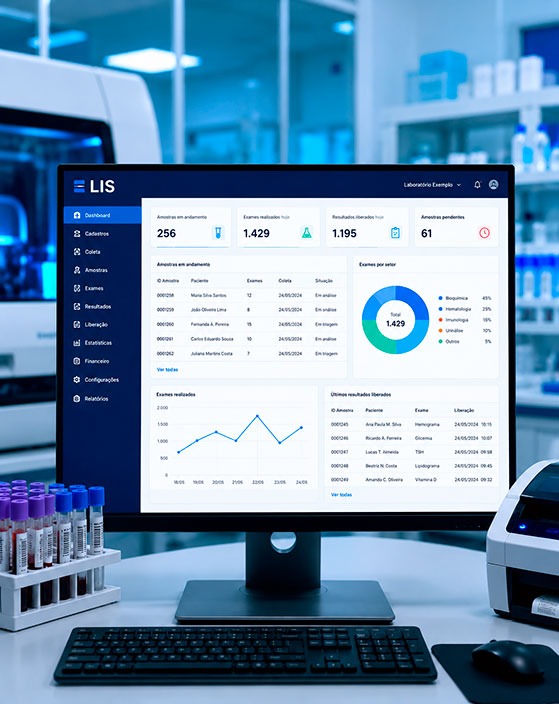
5. Evaluate management resources and indicators.
Currently, a LIS system should not only serve to manage exams. In addition, it must provide relevant information to support decision-making.
Through management reports and dashboards, managers can track various key operational indicators.
For example:
- Volume of tests performed;
- Average time for results to be released;
- Team productivity;
- Rework rates;
- Operational performance.
In this way, the laboratory begins to make decisions based on concrete data and not just on perceptions.
6. Analyze the quality of technical support.
Even the best systems may require support at certain times. Therefore, the quality of service offered by the provider deserves special attention.
Furthermore, efficient support contributes to operational continuity and reduces the impact of potential problems.
During the evaluation, try to understand:
- What customer service channels are available?
- Support hours;
- Average response time;
- Availability for training;
- Frequency of system updates.
This way, you’ll have a clearer picture of the level of support that will be offered after you sign the contract.
7. Check integration with other systems.
Currently, laboratories use various tools to manage their operations. Therefore, it is important that the LIS System can integrate with other platforms.
Among them are:
- ERP systems;
- Financial platforms;
- Electronic medical records;
- Customer service tools;
- Results portals.
Furthermore, system integration reduces rework and improves the flow of information between departments. Consequently, productivity increases and processes become more efficient.
Common mistakes when choosing a LIS system.
During the selection process, some mistakes can compromise the expected results. Therefore, it’s worthwhile to be aware of the most common ones.
Choosing solely based on the lowest price
While cost is an important factor, it shouldn’t be the only evaluation criterion. After all, a limited solution can lead to higher costs in the future.
Ignoring the specific needs of the laboratory
Each laboratory has its own characteristics. Therefore, the chosen system must be aligned with the company’s operational reality.
Failure to assess integration capabilities
Often, a lack of integration leads to rework and reduces process efficiency. Therefore, this aspect should be carefully analyzed.
Disregarding future growth
A system that meets current needs may not keep pace with operational growth. Therefore, the company risks needing to switch platforms in a short time.
Do not involve the team in the evaluation.
Professionals who use the system daily can provide valuable information during the selection process. Therefore, team participation is highly recommended.
Choosing a LIS system is a strategic decision that directly impacts the quality of services provided, team productivity, and the laboratory’s growth potential.
Therefore, the evaluation should go far beyond the price of the solution. In addition, factors such as integration, usability, security, scalability, and technical support need to be carefully analyzed.
By considering all these criteria, managers significantly increase their chances of choosing a solution capable of meeting the current and future needs of the operation.
Ultimately, investing in a suitable LIS system means preparing the laboratory for sustainable growth, increasing its operational efficiency, and offering increasingly better service to patients.
If you have questions about LIS systems, laboratory integration, or process automation, please contact our team at whatsapp. We will be happy to share information that may help in assessing your laboratory’s needs.