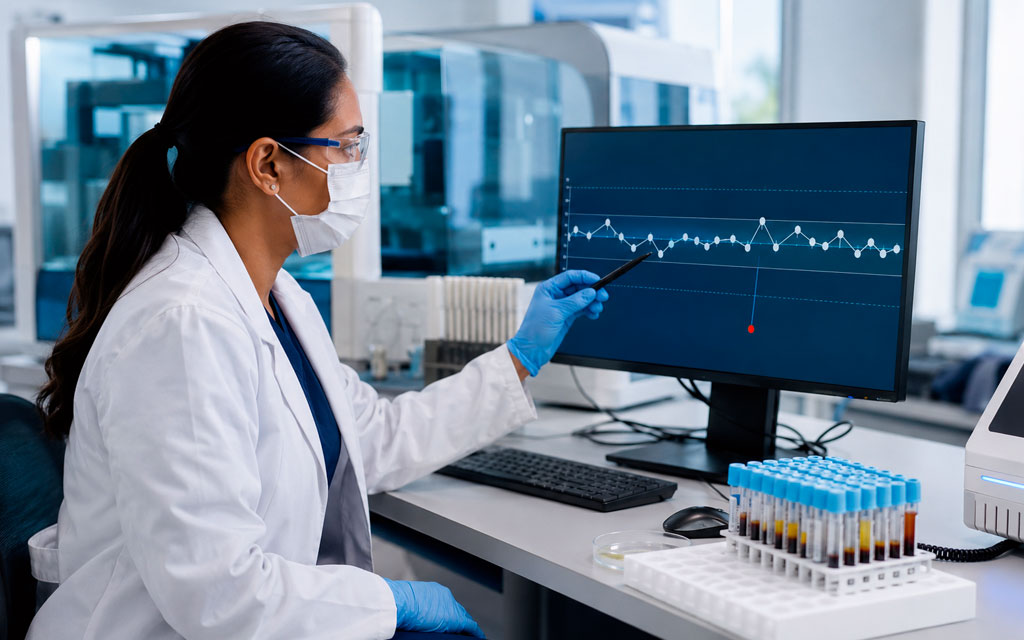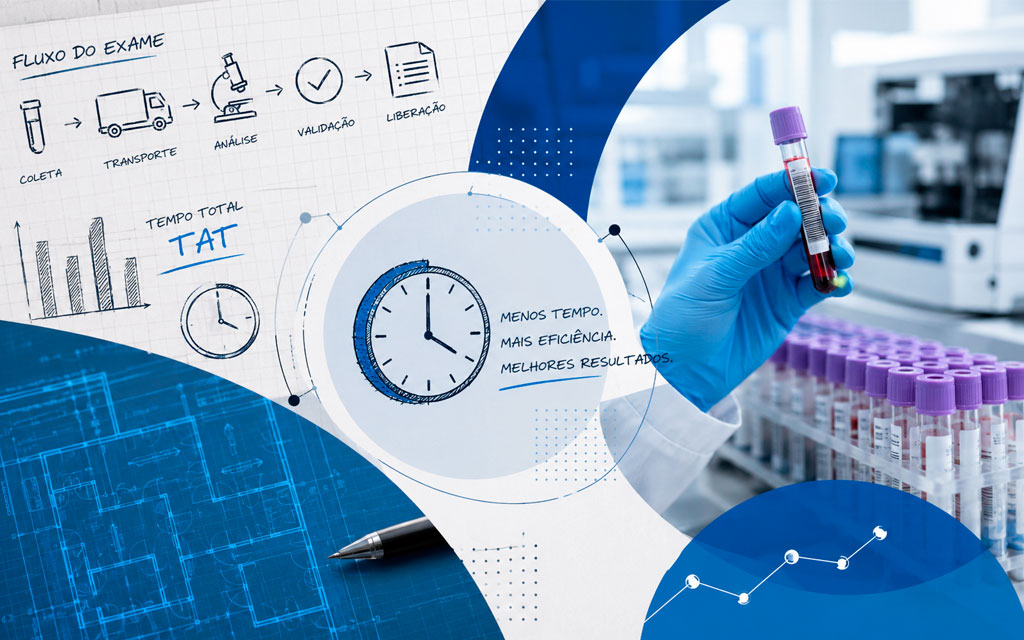

The daily routine of a laboratory involves much more than just performing tests. Patient care, registration, sample collection and identification, processing, validation, results release, and management all need to function in an integrated way.
In this scenario, having a system for clinical analysis laboratories Proper implementation has become essential for organizing processes, reducing manual activities, and providing more control over operations.
However, not every system offers the same features. Furthermore, as the laboratory grows, new needs arise. Integrations, traceability, indicators, security, and access to information become increasingly important.
Therefore, before choosing a solution, it is essential to understand how a laboratory system works and which features truly make a difference in daily routines.
What is a system for clinical analysis laboratories?
A system for clinical analysis laboratories is a technological solution developed to organize and manage the different stages of laboratory operation.
In practice, it centralizes information that might previously have been scattered across spreadsheets, documents, independent systems, or manual processes.
In this way, data related to patients, exams, samples, results, and processes are available within an integrated environment.
A modern system can also communicate with laboratory equipment, external platforms, and other solutions used by the laboratory. Consequently, the flow of information becomes faster and more organized.
How does a laboratory system work?
The operation may vary depending on the solution used and the laboratory’s structure. However, the system typically tracks a large part of the examination process.
The process can begin during the initial consultation, with the registration of the patient and the requested tests. Afterwards, the information goes through stages such as sample collection, screening, processing, validation, and release of results.
When these steps are integrated, the laboratory reduces the need to repeatedly enter the same information into different systems.
Furthermore, each movement can be recorded. This makes it easier to track the progress of the exams and identify any delays or inconsistencies.
What processes can be controlled by the system?
A good system for clinical analysis laboratories should meet the actual needs of the operation. Among the main processes that can be managed are:
Patient registration and care
The service represents one of the first steps in the journey within the laboratory.
At this time, registration information, exam requests, health insurance plans, and other data need to be recorded correctly.
When the system centralizes this information, the team can access the history more easily and avoid duplicate entries or parallel processes.
Furthermore, the integration between customer service and technical departments helps to keep information available throughout the entire operation.
Sample collection and identification
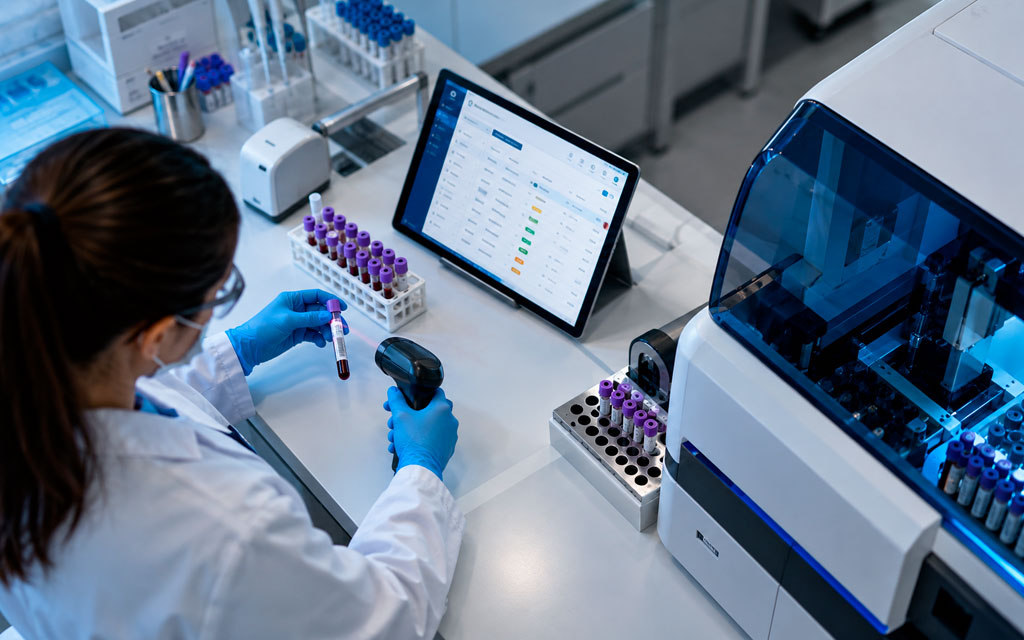
After the initial consultation, an extremely important stage begins: the identification and monitoring of the samples.
The system can help organize data related to the patient, type of exam, material collected, and other information necessary for processing.
Traceability also allows you to track the different stages a sample goes through within the laboratory.
Consequently, the team gains greater visibility into the process.
Integration with laboratory equipment
Integration with equipment is another important feature.
When analyzers and other equipment can communicate directly with the system, some of the information transfer can occur automatically.
This reduces the need for manual data entry and can decrease repetitive tasks.
TM already addresses this topic specifically in its content about interfacing of laboratory equipment This is precisely because this integration plays an important role in automating routine tasks.
Monitoring the processing of exams
With different tests being performed simultaneously, manually tracking each step can become increasingly difficult.
A suitable system allows you to view the progress of exams and identify which processes are still pending.
In this way, managers and teams can identify potential bottlenecks more easily.
Furthermore, centralized information helps create a clearer view of the laboratory’s operational workflow.
Validation and release of results
After the tests are processed, the results need to be analyzed and validated according to the procedures defined by the laboratory.
The system can organize this workflow and record the steps taken.
Furthermore, after release, the results can be made available through different channels, depending on the solution used.
This provides greater efficiency for both the team and the patients and professionals making the requests.
Access to reports and results
Another important feature of current systems is the ability to make results available through digital means.
Web portals, for example, can allow patients or authorized professionals to consult reports without relying exclusively on in-person care.
In addition to facilitating access, this type of resource can also reduce manual requests to the laboratory staff.
At TM Tecnologia, this function can be part of an integrated ecosystem of solutions, in which different tools work together in laboratory management.
Traceability at every stage.
Traceability helps the laboratory understand the path taken by a particular sample or process.
Instead of working only with the final exam results, the team is able to track the records generated during the operation.
This is especially important in environments with a high volume of tests, different sectors, and multiple units or service points.
With centralized data, it becomes simpler to identify at what stage a given process is.
Indicators to support management
A laboratory system doesn’t need to be used solely for operational tasks.
The information generated daily can also be used for management.
Data on test volume, productivity, processing time, and other information can be transformed into indicators.
This allows managers to make decisions based on real data from their own operations.
This concept is directly related to Business Intelligence Laboratory, another topic already covered on the TM Tecnologia blog. TM Tecnologia
Are a laboratory system and a LIS system the same thing?
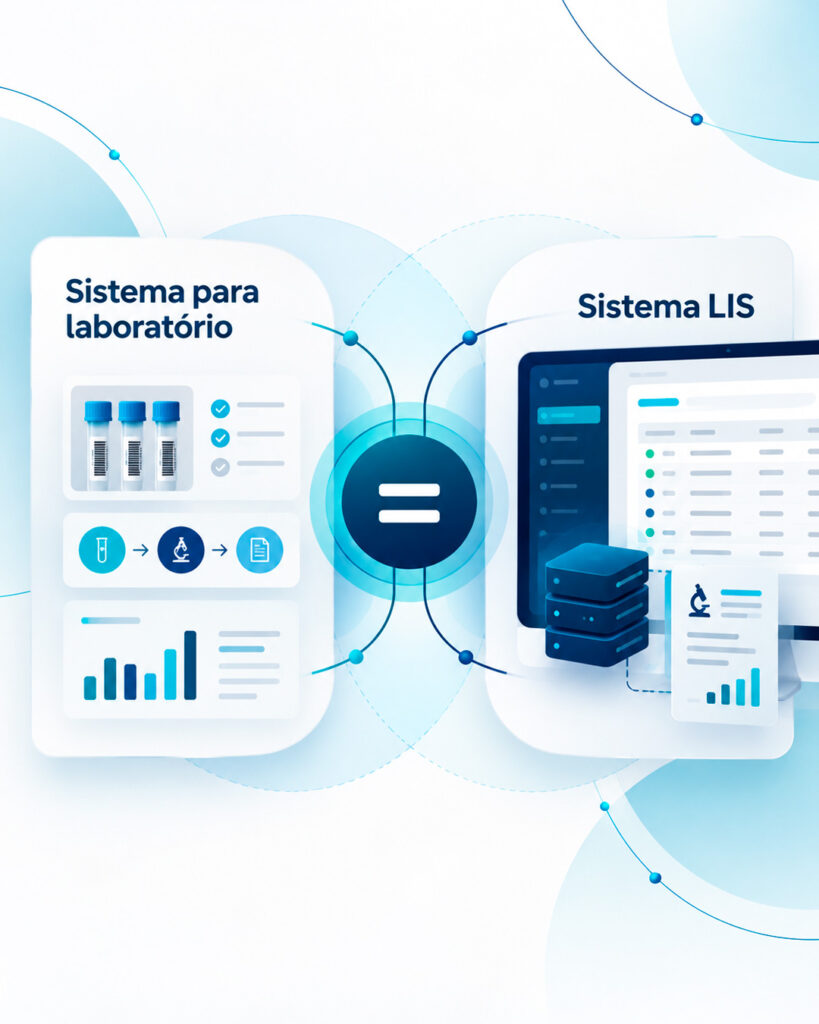
In many cases, when someone searches for a system for clinical analysis laboratory, is specifically looking for a solution known technically as LIS.
LIS is the abbreviation for Laboratory Information System, or Laboratory Information System.
This type of platform was developed specifically to organize and integrate processes related to the daily routines of laboratories.
Therefore, although users may use expressions such as “laboratory software,” “laboratory program,” or “laboratory system,” technically many of these searches are related to the search for a LIS system.
The difference lies mainly in how each person understands or researches the technology.
TM Tecnologia has a specific article explaining this in detail. What is a LIS system and why is it important for clinical laboratories?.
What should you consider when choosing a laboratory system?
Choosing a system based solely on price or number of features may not be enough.
It is important to assess whether the solution can keep up with current processes as well as the future growth of the laboratory.
Some aspects deserve attention.
Integration capability
The system must be able to integrate with the equipment and other solutions used by the laboratory.
The greater the communication between different platforms, the less need there tends to be for parallel manual processes.
Traceability
The ability to track the flow of samples and information helps maintain greater control over the operation.
This feature becomes even more relevant as the volume of tests increases.
Information security
Laboratories work with sensitive information on a daily basis.
Therefore, access control, activity logging, security policies, and data protection should be part of the evaluation.
Easy access to information
The team needs to find what they’re looking for quickly.
An overly complex or poorly organized system can increase the time required to perform simple tasks.
Therefore, usability is also an important factor.
Growth capacity
The laboratory can start with a smaller structure and, over time, expand its units, equipment, users, and volume of tests.
Consequently, the system needs to keep pace with this evolution without becoming an obstacle.
Specialized support
Technological problems can directly impact operations.
Therefore, having a team that understands the realities of the laboratory environment makes a difference, especially in critical situations.
The supplier’s experience in the segment should also be considered during the selection process.
Cloud-based system or on-premises infrastructure?
Another point that deserves attention is the infrastructure used by the system.
Traditional solutions may rely on servers installed within the company itself. On the other hand, cloud technologies allow the use of infrastructure hosted in specialized environments.
The choice should consider factors such as security, availability, scalability, maintenance, and the laboratory’s technological strategy.
THE LISNet For example, it uses Oracle Cloud infrastructure, as presented by TM Tecnologia on its page dedicated to the solution.
Adopting the cloud also reduces reliance on physical infrastructure installed exclusively in the laboratory, although connectivity, security, and availability requirements should always be evaluated.
When should a laboratory consider changing systems?
It’s not always necessary to wait for the system to stop working before considering a change.
Some signs may indicate that current technology no longer meets the laboratory’s needs.
These include excessive manual tasks, difficulty in integration, slowness, lack of indicators, limitations for new units, or difficulty accessing information.
In some cases, these problems end up being incorporated into the routine and begin to seem normal.
Therefore, periodically evaluating the technology used is an important practice.
TM Tecnologia also has specific content about… 5 signs that your lab may need to change its LIS system..
How can technology transform the routine of the laboratory?
The primary function of technology should not simply be to replace a manual process with a digital one.
The goal should be to make the operation more integrated, traceable, and efficient.
When information flows correctly between customer service, technical areas, equipment, and management, the team no longer wastes time searching for data or repeating tasks.
At the same time, managers gain a broader view of the operation.
Therefore, a good system for clinical analysis laboratories needs to function as part of the business structure, and not just as an isolated tool.
LISNet: a system for clinical analysis laboratories.
TM Tecnologia developed theLISNet, a solution focused on data and process management in clinical analysis laboratories.
The system works integrated into TM’s ecosystem of solutions, allowing it to connect different operational needs.
In addition to laboratory management, TM offers solutions related to equipment interfacing, management indicators, materials management, web portals, and other areas of routine laboratory work.
In this way, technology can accompany different stages of the process and support both operation and management.
If your laboratory is looking for a system for clinical analysis laboratories Capable of integrating processes, information, and equipment, understanding the available options is the first step in evaluating which solution best suits your needs.
Want to learn more about TM Tecnologia’s solutions?
Contact us through our WhatsApp (11) 94075-1513