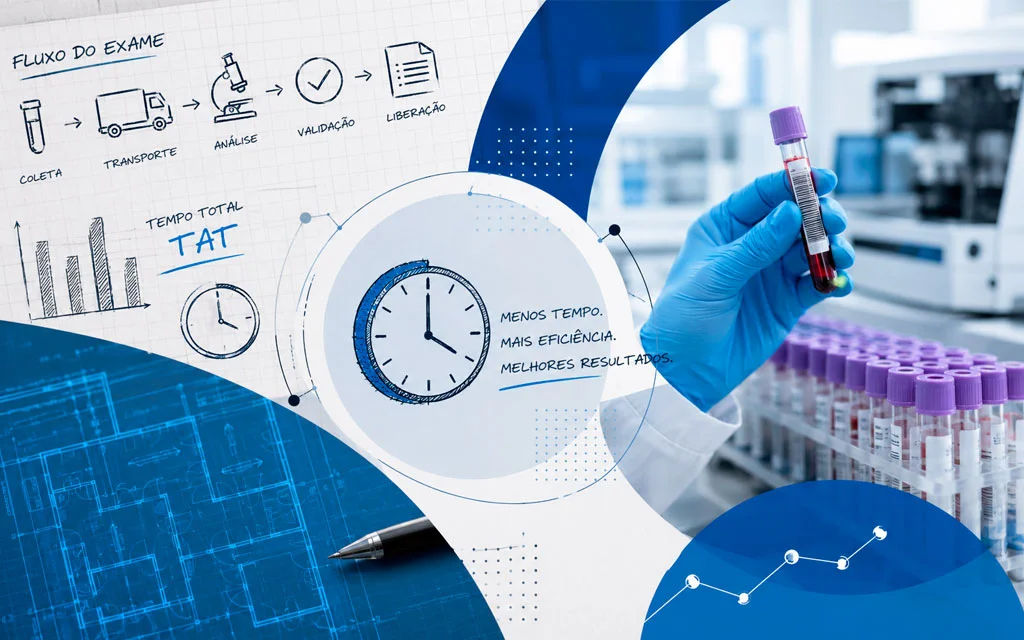

A Logistics Interface (LIS) system is one of the most important tools in the daily routine of a clinical analysis laboratory. It participates in virtually every stage of the operation, from patient registration and sample reception to test processing, result release, and information management.
Therefore, when the system begins to show limitations, the impacts appear in different areas of the laboratory. The team may face more manual tasks, slowness, rework, integration difficulties, and a reduced capacity to keep up with the growth of the operation.
However, it is not always easy to identify the right time to switch LIS systems. In many cases, the laboratory becomes accustomed to certain difficulties and begins to treat them as a normal part of the routine.
Below are five signs that your lab may need to evaluate a new solution.
1. The system is becoming slow or unstable.
As a laboratory grows, the volume of information processed daily also increases.
More patients, exams, equipment, users, units, and integrations require a technological infrastructure capable of keeping pace with this evolution.
When a system frequently experiences slowdowns, crashes, or difficulty performing tasks that were previously simple, the current solution may no longer be able to handle the volume of operations.
Furthermore, performance issues harm team productivity. Consequently, the laboratory may face queues, delays in service, and increased time required to release results.
Therefore, a suitable LIS needs to offer stability and performance even when the laboratory expands its operations.
2. Your team still relies on many manual processes.

Parallel spreadsheets, paper notes, repetitive typing, and manual checks are some examples of activities that indicate low process automation.
The greater the dependence on these tasks, the greater the risk of errors.
In a clinical analysis laboratory, information circulates through several stages. Therefore, when systems do not adequately automate these flows, employees end up creating alternatives to overcome the limitations.
The problem is that these parallel solutions increase rework and make it difficult to trace information.
Furthermore, manual processes consume time that the team could dedicate to more strategic and important activities for the operation.
Therefore, a modern LIS system should eliminate unnecessary steps and automate processes whenever possible.
3. Integrating equipment and other systems has become a problem.
Integration plays a fundamental role in laboratory operations.
Analyzers, automation equipment, service systems, results platforms, and other solutions used by the laboratory need to exchange information reliably.
However, when each new integration requires complex processes or when the team needs to manually enter results, the operation loses efficiency.
The integration between equipment and the LIS allows, for example, results to automatically reach the system. This reduces manual steps for the laboratory and increases the speed of test processing.
Furthermore, an integrated environment facilitates the company’s technological expansion.
Therefore, if the current infrastructure constantly hinders the implementation of new integrations, this may be a strong sign that it’s time to evaluate another LIS system.
📌 READ ALSO:LIS System: What it is, how it works, and why it’s essential for laboratories.
4. You have difficulty keeping track of information and indicators.
A laboratory generates a large amount of data every day.
Examination volume, productivity, processing time, pending items, billing, and operational performance are just a few examples of important information for management.
These indicators help managers identify bottlenecks and make decisions more quickly.
However, the system doesn’t always provide this information in a simple way.
When managers need to request reports, export spreadsheets, or gather data from different sources to understand what is happening in operations, the laboratory loses some of the potential of that information.
Furthermore, the more time the team spends consolidating data manually, the less agile they are in acting when problems arise.
Therefore, a laboratory management system should facilitate access to information and allow managers to use this data strategically.
Ultimately, having data isn’t enough. It’s necessary to transform it into useful information to support decision-making.
5. The current system is limiting the growth of the laboratory.
Perhaps this is one of the most important signs.
When a laboratory wants to open a new unit, integrate new equipment, increase the volume of tests, or implement new services, the system should not become an obstacle.
If this happens, it’s important to assess whether the technology is still aligned with the company’s objectives.
A LIS (Laboratory Information System) should support the growth of the laboratory. Furthermore, it needs to offer a structure capable of keeping pace with the expansion of operations over time.
This involves processing capacity, integration between units, user control, information security, traceability, and tools that help to continuously improve internal processes.
Therefore, when technology hinders new projects or makes each expansion excessively complex, the laboratory may be facing a clear sign that it needs to change its LIS system.
Switching LIS systems requires planning.
Identifying these signs does not mean that the laboratory needs to change systems immediately.
Replacing a laboratory management platform involves several steps. Therefore, the company must carefully plan this change.
Before choosing a new solution, it is important to evaluate the laboratory’s current processes, understand the main bottlenecks, and define which functionalities truly make a difference to the operation.
In addition, the team should consider aspects such as integration possibilities, information security, scalability, support, and the platform’s ability to evolve.
It’s also worth analyzing how the implementation process, user training, and data migration will work.
Therefore, good planning reduces impacts during the transition and increases the chances of success for the new project.
Technology must keep pace with the evolution of the laboratory.
The LIS system occupies a central position in the operation of a clinical analysis laboratory.
When technology keeps pace with company growth, the laboratory can automate tasks, reduce rework, improve information traceability, and provide better conditions for managers and teams to work more efficiently.
Furthermore, adequate infrastructure facilitates new integrations and allows operations to evolve without constantly relying on makeshift solutions.
On the other hand, when the laboratory needs to adapt its processes to the limitations of the system, the time may come to consider a change.
TM Tecnologia develops solutions exclusively for clinical analysis laboratories.
Th eLISNet It supports different stages of laboratory operation and helps integrate processes, information, and resources that are important for laboratory management.
Therefore, if some of the signs presented in this article are already part of your company’s routine, it’s worth evaluating whether the technology currently used still meets the operational needs.
Discover TM Tecnologia’s solutions and find out how LISNet can contribute to the evolution of your laboratory.