

Agility and efficiency go hand in hand.
In a laboratory setting, the speed at which test results are released directly influences the quality of care and patient satisfaction.Furthermore Results delivered faster allow doctors to make clinical decisions more quickly, especially in situations that require rapid intervention.
In this context theTAT Laboratorial (Turnaround Time)It has become one of the main performance indicators for clinical laboratories.In the endI t reveals how efficient internal processes are and highlights opportunities to optimize routines without compromising the quality of results.
What is a Laboratory TAT?
The Turnaround Time (TAT)This represents the time required for a test to go through all stages of the laboratory process, from receiving the sample to releasing the report.
In general This period includes activities such as:
- Patient registration;
- Sample collection and identification;
- Internal transport;
- Analytical processing;
- Technical and biomedical validation;
- Issuance and release of the result.
That way Monitoring the TAT allows you to identify exactly where delays occur and which steps need improvement. Consequently This allows the laboratory to operate more strategically to increase its operational efficiency.
Why is reducing TAT so important?
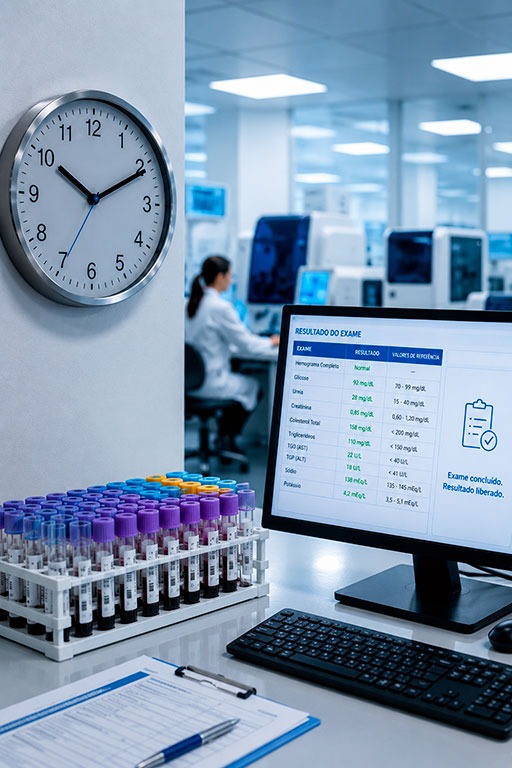
Reducing the TAT (Time to Accept) generates benefits for everyone involved in the process.
For the patient, it means receiving results in less time, reducing anxiety and allowing for a faster start to treatment when necessary. In the same way This allows doctors to have access to clinical information in a shorter timeframe, making their decision-making faster and more reliable.
Further more Laboratory management also benefits. Among the main gains are:
- Increased team productivity;
- Better use of equipment;
- Reducing rework;
- Increased operational capacity;
- Greater satisfaction for patients and partners;
- Strengthening the laboratory’s credibility.
There fore Investing in reducing TAT (Time to Accept) means not only speeding up processes, but also improving the quality of services provided.
What increases the turnaround time for test results?
Even laboratories with modern equipment may face difficulties in reducing the TAT. This happens because Often, the bottlenecks are related to internal processes and not to the technology used.
Manual processes
Typing results, repetitive checks, and manual record-keeping consume time and increase the possibility of errors. As a result The entire operation becomes slower.
Lack of integration
When analyzers, systems, and different departments are not connected, several tasks need to be performed manually. Consequently The workflow loses efficiency and response time increases.
Rework
Registration errors, data recollections, and inconsistencies in information require further verification. Furthermore These occurrences impact other areas of the laboratory, further increasing the time required to release test results.
Lack of monitoring
Without real-time updated indicators, it becomes difficult to identify bottlenecks before they affect the entire routine.Like this Small mistakes end up turning into bigger problems.
How to reduce TAT efficiently?
Improving TAT requires an integrated view of the processes. In other words It’s not enough to just work faster; it’s necessary to eliminate activities that don’t add value to the laboratory workflow.
Key practices include:
- Automate repetitive processes;
- Integrate equipment into the LIS system;
- Standardize operational workflows;
- Implement full sample traceability;
- Monitor indicators in real time;
- To identify and correct bottlenecks continuously.
When these actions are implemented together The laboratory reduces waste and increases its productivity in a sustainable way.
📌 Read also: Errors in the pre-analytical phase: how to reduce failures in laboratories.
The role of technology
Digital transformation has become an important ally for laboratories seeking operational excellence. In that regard, one Laboratory Information System (LIS) It automates several steps in the routine and significantly reduces reliance on manual processes.
Further more The integration between equipment, sectors, and professionals provides a more continuous and reliable workflow. On the other hand Management dashboards allow you to track indicators in real time, making it easier to identify opportunities for improvement.
As a consequence Managers are able to make data-driven decisions, reducing TAT without compromising the quality of the tests.
Agility without sacrificing quality.
There is a common misconception that reducing the turnaround time for test results means speeding up important steps. However That doesn’t correspond to reality.
When a laboratory invests in automation, integration, and process monitoring, it eliminates waste and reduces unnecessary activities. Like this Agility is achieved without compromising the security, traceability, or reliability of the results.
At the same time This gives the team more time to dedicate to activities that truly require technical knowledge and critical analysis.
The Laboratory TAT is much more than a performance indicator. In practice It reflects the operational efficiency, the organization of processes, and the laboratory’s ability to offer increasingly agile and reliable service.
That’s why Investing in automation, systems integration, and continuous monitoring of indicators should be part of the strategy of any laboratory seeking sustainable growth.
In an increasingly competitive environment Reducing the turnaround time for test results represents a significant advantage. In addition to To improve the experience of patients and healthcare professionals, this evolution strengthens the institution’s credibility and contributes to more efficient management, better prepared for the challenges of the future.